
Psychological Safety Isn’t About Comfort. It’s About Performance.
Psychological Safety Isn’t About Comfort. It’s About Performance.
Psychological safety is often misunderstood in professional environments, particularly in healthcare. It is sometimes dismissed as a “soft” concept associated with comfort or emotional ease rather than measurable performance.
Psychological safety is about creating the conditions that allow individuals and teams to perform effectively, especially in high-pressure environments where communication and collaboration directly impact outcomes.
Psychological safety refers to a shared belief that team members can speak up, ask questions, admit uncertainty, or raise concerns without fear of embarrassment or punishment. Research has consistently shown that when this environment exists, teams are more likely to learn, adapt, and address problems earlier.
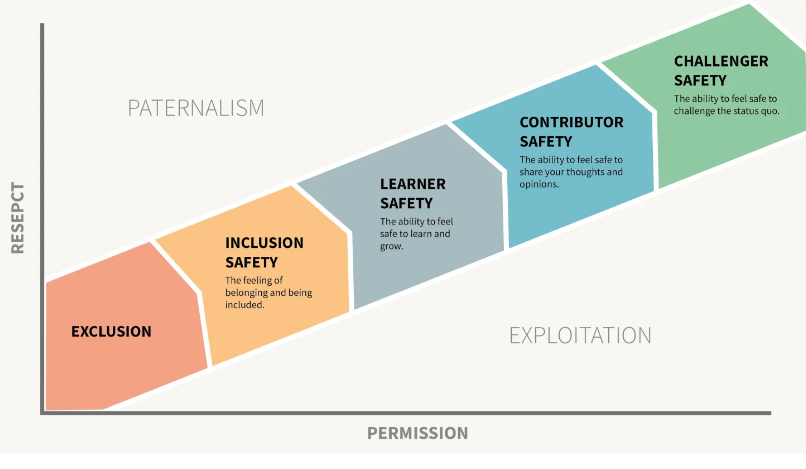
This diagram visually emphasizes the progression from exclusion to full psychological safety, highlighting how respect and permission interact to create a safe environment for learning, contribution, and challenging ideas.
The Cost of Silence
In high-stakes settings such as healthcare, hesitation can have significant consequences.
When individuals feel unsafe speaking up, they may avoid:
questioning unclear decisions
clarifying instructions
sharing observations
reporting near misses or mistakes early
This silence does not reflect a lack of competence or dedication. Instead, it reflects an environment where interpersonal risk feels unsafe.
Research indicates that psychological safety encourages team members to voice concerns, which supports patient safety, learning, and continuous improvement.
Psychological Safety and Accountability Work Together
One of the most common misconceptions is that psychological safety lowers expectations.
Evidence suggests the opposite.
High-performing teams balance psychological safety with clear accountability. Safety enables honest communication, while accountability maintains performance standards. Without safety, accountability often becomes fear driven. Without accountability, safety can become avoidance.
Effective teams require both.
Why Psychological Safety Matters in Healthcare
Healthcare professionals are trained to prioritize patient care, often at the expense of their own emotional needs or communication challenges. Over time, environments lacking psychological safety can contribute to emotional exhaustion, reduced engagement, and decreased collaboration.
When psychological safety is present:
team members are more willing to speak up
errors are identified earlier
learning becomes continuous rather than reactive
Importantly, psychologically safe teams do not necessarily make fewer mistakes, they are more likely to report and address them, which strengthens performance over time.
Leadership’s Role in Creating Safety
Psychological safety does not emerge by accident. It is shaped by leadership behaviors, team norms, and daily interactions.
Leaders foster psychological safety when they:
respond to concerns with curiosity instead of blame
invite input from all team members
normalize uncertainty and questions
model accountability alongside openness
These behaviors signal whether speaking up is genuinely safe or merely encouraged in theory.
Moving Beyond the “Soft Skill” Myth
Labeling psychological safety as “soft” minimizes its impact. In high-performing environments, it functions as a structural component of effective teamwork.

When organizations invest in psychological safety, they are not lowering expectations. Instead, they are strengthening communication, increasing learning capacity, and improving team resilience.
